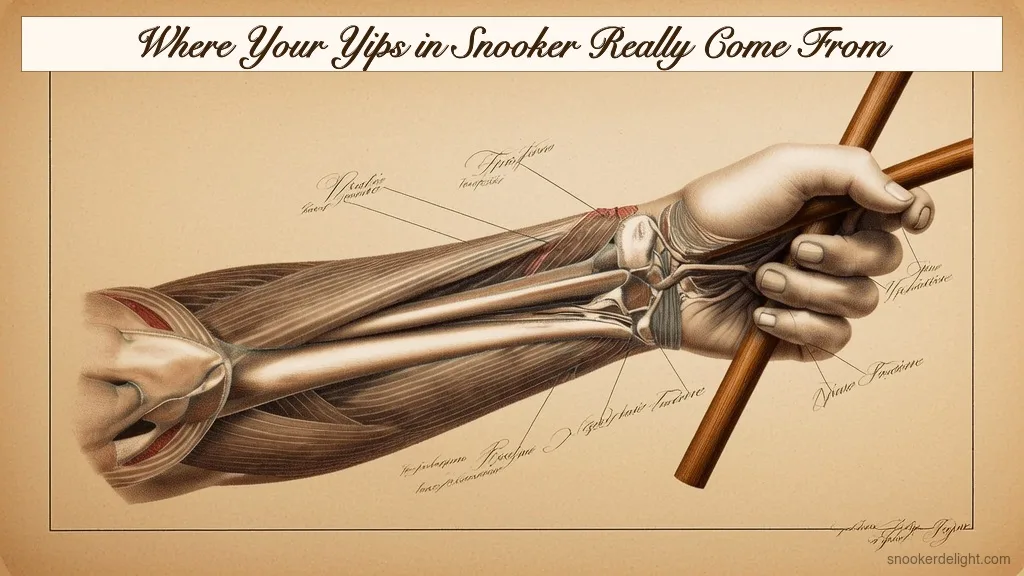
The common belief is that yips come from age. That they creep in as you get older — deteriorating nerves, shaky hands, fading confidence. Maybe. I won’t dismiss that entirely. But I think there’s something else going on that most players never consider — and it’s far more actionable than blaming the calendar.
In my experience, yips come from poor information. Specifically, they come from poor awareness — awareness of your equipment, awareness of your shot, and awareness of your relationship to the opponent. Three sources that have nothing to do with age. All of them fixable.
But first — what a yip actually is.
The Anatomy of a Yip
A yip is the moment your body refuses to execute what your brain hasn’t fully resolved.
You feel it in the delivery. The backswing tightens. The follow-through shortens or vanishes. The grip clenches at exactly the wrong moment. The cue jerks forward instead of flowing. Sometimes the whole stroke freezes — you’re stuck at the back, unable to pull the trigger. Other times you snatch at the ball, rushing through the hesitation before it can fully register.
Either way, the result is the same: a delivery that’s fighting itself. The cue goes forward, but nothing about it is committed. And the shot — predictably — fails.
Here’s what people get wrong. They think the yip is a physical problem. A nerve issue. A coordination breakdown. It isn’t. It’s a data problem. Your body is reacting to uncertainty the only way it knows how — by hesitating. It’s saying: I don’t have enough information to commit to this action. And then it panics.
The yip lives in the gap between “I think I know” and “I know.”
If you watch Stephen Hendry’s YouTube channel carefully — not just the entertainment, but how he describes his peak years — you notice something. Hendry was extraordinarily direct in his approach. He got down and played the shot. There was no deliberation once he was on the cue ball. No second-guessing. No moment of uncertainty between preparation and delivery. He dropped into the shot line and the cue went forward with total certainty.
That’s not natural talent. That’s what happens when the information is complete. When the decision is finished before you get down, and the body has everything it needs to execute without interference. The opposite of a yip isn’t courage. It’s certainty.
So where does that certainty break down?
1. Your Equipment Changed
This is the most predictable cause of yips and the least talked about.
You change your cue. Or your tip. Or your chalk. Or your ferrule. Even the weight balance. And within days — sometimes within hours — shots that used to be automatic start feeling uncertain. Pots you’d normally back yourself on suddenly carry a flicker of doubt. Your hand knows something is different, even if your conscious mind hasn’t caught up.
I’ve written about this at length: your cue action is an instrument you tune. The cue is part of that instrument. It’s not separate from your action — it’s embedded in it. Your body has calibrated itself to this specific weight, this specific balance, this specific deflection character, over thousands of shots. Change any of it and the calibration is off.
Even if the new cue is objectively better. Even if it’s more expensive, better balanced, made from better wood. Doesn’t matter. Your body doesn’t care about objective quality. It cares about the feedback loop it’s built. And you just broke it.
The yip appears because you’re trying to execute shots using old data that no longer applies. Somewhere in the transaction — the last inch of the stroke, the moment of contact — your hand registers a mismatch between what it expects and what it gets. That mismatch becomes doubt. The doubt becomes hesitation. The hesitation becomes a yip.
Professionals don’t suffer from this as much because they play all day. They recalibrate constantly, unconsciously. If Judd Trump changes a tip, he’ll hit a thousand balls that week and the new character gets absorbed. The rest of us change something, play three sessions, wonder why everything feels wrong, and then blame our nerves.
The fix is a deliberate reset. Several sessions of straightforward pots — nothing fancy — with your full attention on the gap between expectation and reality. What do you think the cue ball will do? What does it actually do? Close that gap with conscious attention and the yips disappear because the uncertainty disappears.
I’ll write more about this reset protocol soon. But the principle is simple: you can’t commit fully to a shot when your body doesn’t trust its own predictions. Rebuild the trust. The commitment follows.
2. You Haven’t Thought the Shot Through
This is the one that shows up most often in match play. The yip that comes from getting down before the decision is complete.
I wrote recently about the one-shot mindset — deciding the shot fully before you get down, then committing to nothing but execution once you’re there. That piece came directly from discovering this in tournament play. Every time I felt hesitation on a shot, I could trace it back to the same cause: I hadn’t finished thinking.
A lot of players who describe themselves as “natural” are really just playing on emotion and feel. They get down with a general idea and figure out the specifics in the feathers. Sometimes it works. Often enough that they never question it. But under pressure — when the frame matters, when they’re cold, when the opponent is scoring — it falls apart. Because there’s nothing to fall back on. The “natural” approach was never a system. It was an absence of one.
The word I keep coming back to is unexamined. An unexamined approach to the table works fine in comfortable conditions. It falls apart the moment conditions change. And you can’t fix it by trying harder or caring more. You fix it by building something reliable.
I played for years this way. I could recognize and execute the shot line with high regularity. I potted well. But I couldn’t control the cue ball because I never thought about where I was striking it. I never visualized the center ball line first. I never chose a specific point on the cue ball before getting down. I was making half-decisions and hoping my hand would sort out the rest.
My approach now is different. I pause twice — front and back. I choose a deliberate strike point. I visualize the cue ball’s destination. I can feel it in the back pause — the shot already played in my mind before the cue moves forward. And the hesitation is gone, because there’s nothing left to hesitate about. The information is complete.
But this isn’t only about what happens when you’re down. A complete system includes where you stand. Where your delivery hand sits in space — it should be behind the shot line. How you approach — leading with the head is best. If any of these are off before you get down, your brain registers it. Not consciously. But enough to create doubt. And doubt is where the yip lives.
Though this might look like art when done well, you aren’t painting in snooker. There are mechanical, repeatable patterns that exist — pausing, eye movement, body awareness, delivery timing. These aren’t things that destroy natural play. They’re what make natural play reliable. Players can and should build a cue action system. A system you trust is a system that doesn’t yip.
Shaun Murphy is a good example. He’s described in interviews that he constructed his cue action deliberately from a young age. He didn’t find it by feel — he designed it. And whatever you think of his style, the man performs under pressure. That’s not coincidence. A designed system gives you something to lean on when the stakes go up. A “natural” player with no system has nothing to lean on except confidence — and confidence is the first thing to go when you’re behind in a frame.
3. You Feel Inferior to Your Opponent
This one is harder to solve because it’s more emotional. But the mechanism is the same.
When you play someone better — or someone you believe is better — something shifts in your decision-making. You stop playing your game and start playing theirs. You rush, because they’re scoring and you feel behind. You attempt shots you haven’t earned, because their game makes yours feel inadequate. You abandon the shot selection principles that normally serve you because suddenly they seem insufficient against this opponent.
And then you yip. Not because you’re nervous — because you’ve stopped making decisions based on what you can do. You’re trying to execute shots that don’t belong to your current game, and your body knows it. That uncertainty — the gap between ambition and ability — produces the same hesitation as any other yip.
Knowing your own game is essential here. If you can’t play a deep screw reliably, don’t attempt it. Don’t worry that your opponent can. They’ve earned that shot through their practice. You’ll earn it through yours. Right now, you play the shots that are right for you — the ones you can commit to fully because you know they’re within your range.
In handicap tournaments, the arithmetic is already done for you. The points you’re giving or receiving exist to level the field. The opponent is playing their A-game and the handicap ensures you’re competing on equal terms. I found this to be exactly true in my recent 6-red tournament. I played a lower-handicapped player, giving 10 points, and had to bring my absolute best — safety, potting, shot assessment, turning down anything below 70/30 — to win.
When you play someone better, here’s a useful frame: they will perform below their peak at some point. Everyone does. And you will perform your A+ game. This sounds like wishful thinking but it’s closer to reality than you’d expect. You have no idea what’s in your opponent’s mind. Did they change cues recently? Are they rushing? Are they taking liberties with shot selection? Are they giving you chances they shouldn’t?
Watch for the signs. Even one time they put in a quick one — a rushed shot, a careless attempt — should tell you they aren’t at their best. And that should be enough for you to commit to your process. Play your best game. One shot at a time.
Mark Williams is worth studying here. He’s 49. He doesn’t yip. One reason is mechanical — his cue action is extraordinarily simple and low-movement. Not quite Marco Fu, who doesn’t feather at all, but Williams doesn’t feather much. There’s less to go wrong under pressure because there’s less moving in the first place.
But the bigger reason is mental. Williams has specifically said he doesn’t worry about losing. He’s said it repeatedly, in different interviews, over many years. That mindset gives him freedom to commit fully to every shot, because there’s no fear-based interference in the decision. He’s widely recognized as the greatest single-ball potter the game has ever produced. That’s not an accident. That’s what happens when commitment is total and doubt is absent. Every shot is one shot. His shot. Fully backed.
The Cure Is Examination
Yips can be solved. I’m certain of this. But only through examination.
And here’s where people flinch — because “examination” sounds like becoming mechanical. Like losing your flair. Like turning something beautiful into something boring. It isn’t. Examination is how you earn the natural play that holds up when it matters. You don’t get to skip this step. There’s no shortcut through awareness. You either know your game or you don’t, and the yip is what happens when you don’t.
Look at the three sources again. Equipment — you solve it by examining what’s changed and recalibrating. Visualization — you solve it by examining your pre-shot process and building a complete system. Opponent — you solve it by examining your own game honestly, knowing what you can and can’t do, and playing within that range.
Every single one is solved by looking more closely. Not less. Not by relaxing. Not by “just not thinking about it.” By knowing.
I don’t think you can cure yips any other way. “Just play” doesn’t work when the foundation is uncertain. “Trust yourself” doesn’t work when you haven’t given yourself anything trustworthy to rely on. The natural stage — that flow state where you just see shots and play them — doesn’t arrive by ignoring mechanics. It arrives on the other side of understanding them. You go through examination to get beyond it.
It’s similar to life itself, honestly. An unexamined life is a difficult life. If you don’t inspect your thinking and your actions, you can’t form a system. You can’t build something reliable. This is true in business, in career, in how you treat people — and of course in snooker.
The thesis is simple: one shot at a time, fully committed. But full commitment is only possible when the awareness is complete. When you know your equipment. When you’ve visualized the shot entirely. When you’re playing your game, not someone else’s.
That’s where the yips end. Not in courage. In certainty.
An unexamined cue action is a yip waiting to happen.
Comments
No comments yet. Be the first!
Leave a Comment