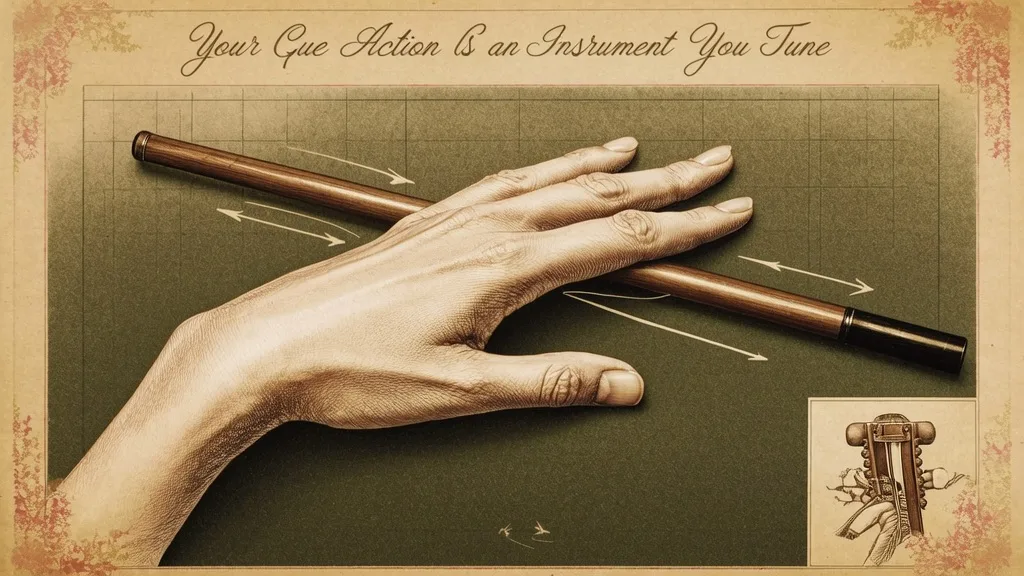
I had a conversation recently with a player who’s been at the game for forty years — with an eighteen-year break in between. He said something that I think a lot of experienced players feel but rarely articulate: I believe we all have different physiques and styles, and need to find our own individual way to sight, walk in, and deliver the cue in a straight line.
He’s right. And I want to expand on why.
The Cookie Cutter Problem
There’s a standard model of cue action that gets taught everywhere. Feet here. Elbow there. Chin on the cue. Grip loose. Follow through straight. And look — none of that is wrong. These are good general principles. They represent decades of accumulated knowledge about what tends to work.
But here’s the thing: they’re starting points, not destinations.
I’ve seen players try to force themselves into a textbook stance that doesn’t fit their body. They’re uncomfortable. They’re tense. They miss shots they used to make. And then they think they’re the problem — that they just can’t do it right. But the real problem is that they’re trying to wear someone else’s suit.
Every body is different. Arm length, torso height, shoulder width, eye dominance, flexibility — all of it matters. Two players can have mechanically sound cue actions that look completely different from each other. That’s not a flaw. That’s how it’s supposed to work.
Muscle Memory Is Alignment Intelligence
Here’s how I think about what we call “muscle memory.” It’s not really memory in the way we normally use that word. It’s more like an alignment system — a self-correcting intelligence that your body develops over thousands and thousands of shots.
Every time you pot a ball, your body registers something. Not consciously. Not in words. But somewhere in the wiring between your eyes, your arm, your shoulder, and your hand, a signal gets reinforced: this worked. And over time, those signals accumulate into something remarkably precise. Your body learns how to align itself to the shot without you having to think about every moving part.
This is why experienced players can step to the table and just know when they’re on the shot. It’s not magic. It’s thousands of repetitions building an internal model of what “straight” feels like. Your alignment intelligence.
That feeling of not having to think about every moving part — of just stepping down and delivering — that’s flow state. It’s what happens when your alignment intelligence is running the show and your conscious mind gets out of the way. You’re not calculating. You’re not checking. You’re just playing. And the shots go in. I’ve written about flow state before — it’s deeply connected to this idea. The more tuned your instrument is, the easier it is to enter flow. Because flow requires trust in your own system. And trust comes from repetition.
And here’s the important part: that intelligence is yours. It’s specific to your body, your stance, your grip, your eyes. It’s not transferable. You can’t copy someone else’s alignment intelligence any more than you can copy their fingerprint. In fact, if you try to copy someone else’s system, you end up going “out of tune.” You introduce conflict between what your body has learned and what you’re forcing it to do. The result is hesitation, inconsistency, and missed shots you used to make.
Your Cue Is Part of the Instrument
This is something almost nobody talks about, and I think it’s one of the most underappreciated aspects of the game.
Your cue is not just a stick you hit balls with. It’s part of your alignment system. The micro-deflection characteristics of your specific cue — how it flexes, how it responds to side, how it feels in your bridge hand — all of that gets woven into your body’s alignment intelligence over time. Your body doesn’t just learn how to cue straight. It learns how to cue straight with that cue.
In fact, it’s so specific to your cue that even your tip plays a role. Every cue I buy, I always re-tip with the same tips: Elkmasters. I know everyone uses layered tips now, but I’m not a fan — especially for players who already have an instrument they’ve developed. Your tip is the final point of contact between your alignment system and the cue ball. Change that contact point and you change the feedback loop. If you’ve spent years calibrating your touch and spin with a particular tip feel, switching to something harder or softer or more compressed throws off the signals your body relies on. Stick with what you know.
This is why, when you pick up a new cue, it either clicks immediately or it doesn’t. And a cue that feels terrible to you might be perfect for someone else. It’s not about the cue being objectively good or bad. It’s about whether its characteristics match the alignment system you’ve already built.
Think about Stephen Hendry. Since his original maple cue broke, he’s never been quite the same. That specific piece of maple, with its specific grain, density, and flex characteristics, was irreplaceable. I don’t have much personal experience with maple cues, but I do get a general sense that maple doesn’t resonate or give me the same feel that ash does. I suppose this makes sense — maple is rock hard, on average about 20% harder than ash, so the feedback through the bridge and cueing hands are fundamentally different. The cues I’ve used have all been ash, and that’s what my alignment system is built around. Hendry’s system was built around that one specific piece of rock-hard maple. When it broke, the instrument broke with it.
When you’ve spent twenty years building an alignment system around a specific piece of wood, losing it is like asking a wood violin player to start performing with a carbon fibre violin. It’s not the same and they will never feel what they felt before. A new student could pick up carbon fibre and appreciate it — they’d build their entire system around its characteristics from day one. But a seasoned player can’t make that switch and shouldn’t try. Unless you’re the Ronnie O’Sullivan of violinists, that is — someone so freakishly adaptable that the rules don’t quite apply.
The Guitar String Analogy
So if your cue action is an instrument, how do you tune it? How do you get better?
I think of it like building a guitar, one string at a time.
When you first start playing — or when you come back after a long break — you’re working with a three-string guitar. You have a limited range of shots you can make reliably. Straight pots. Simple angles. Shots where the alignment is obvious and the margin for error is wide. That’s your instrument right now. Three strings. And that’s fine.
The way you add strings is not by overhauling your technique. It’s by introducing specific shots that stretch your current range — shots you would classify as “difficult” given where you are right now — and practicing them with deliberate attention to how your body solves the alignment problem.
Maybe it’s a thin cut you’ve always struggled with. Maybe it’s a long pot into the top corner. Maybe it’s a specific angle with side spin that you’ve never felt confident on. Whatever it is, you take that shot and you practice it — not mindlessly, but with awareness. You’re watching how your body figures it out. You’re letting your alignment intelligence expand.
And over time, that shot moves from “difficult” to “reliable.” You’ve added a string. Your instrument now has more range.
Here’s something interesting: as you add more strings — as your range expands — you naturally start to look more like a textbook player. More like a Steve Davis. Not because you copied the textbook, but because the textbook describes what a fully tuned instrument looks like. Early on, maybe at the pre-20 break level, you figure out that having one straight leg helps with stability so you aren’t moving sideways. You didn’t read that in a manual. Your body discovered it because it needed it. The “correct” form emerges from the tuning process itself. The textbook is a description of the destination, not a set of directions for getting there.
Sighting and Non-Sighting Techniques
There are specific approaches I use — both sighting techniques (where you use visual reference points to check your alignment) and non-sighting techniques (where you rely on feel, rhythm, and body awareness) — to help players add strings to their instrument.
Some of these are about giving your eyes better information. Some are about removing visual noise so your body can do what it already knows how to do. Some are about introducing controlled difficulty so your alignment system is forced to adapt and grow.
I won’t detail all of them here — I’ll write about specific techniques in future posts. But the principle is always the same: you’re not fixing something broken. You’re tuning something that already works and expanding its range.
What This Means for Practice
If you accept this model — that your cue action is a self-tuned instrument rather than a textbook form to copy — then your practice changes.
You stop trying to look like someone else at the table. You stop obsessing over whether your elbow is in exactly the right position according to some coaching manual. Instead, you ask: can I deliver the cue straight on this shot? And if you can, your mechanics are working — regardless of what they look like from the outside.
Your practice becomes about expanding range rather than enforcing conformity. You identify the shots that are currently outside your reliable range — the shots where your alignment intelligence hasn’t yet built a strong model — and you work on those specifically. Not by thinking about mechanics. By doing the shot until your body figures it out.
And you protect your instrument. You respect the fact that your cue, your stance, your rhythm — all of it is interconnected. Changing one thing changes everything. That doesn’t mean you never change anything. It means you change things deliberately, one at a time, and you give your alignment system time to adapt.
Coming Back After a Break
For anyone returning to the game after years away — and I know there are many of you — here’s the good news: your alignment intelligence doesn’t disappear. It atrophies, but it doesn’t die. The neural pathways are still there. They just need to be reactivated.
The bad news is that it takes time. And during that time, you’ll feel like you’ve lost something. You’ll remember being able to make shots that now feel impossible. That’s normal. You haven’t lost the ability. You’ve lost the sharpness. And sharpness comes back with repetition.
Start with your three-string guitar. Find the shots you can still make reliably — even if that range is smaller than it used to be. Build from there. Don’t try to play like you did before the break. Play like someone who’s tuning their instrument back up. Because that’s exactly what you’re doing.
The Role of Coaching
If this is how cue action works — if it’s a self-tuned instrument rather than a template to impose — then what’s the role of a coach?
A coach isn’t there to give you a new cue action. A coach is there to help you tune the one you have. To identify where your alignment system is breaking down. To suggest adjustments that work with your body rather than against it. To introduce the right challenges at the right time so your instrument grows.
A good coach watches how you play and sees what your body is trying to do. Then they help you do it better. They don’t replace your system with theirs. They refine yours.
That’s the difference between coaching and instruction. Instruction says “do it this way.” Coaching says “let’s figure out what works for you and make it more consistent.”
Your cue action isn’t broken. It’s an instrument. Tune it.
If any of this resonated with you — or if you’re working through your own mechanics and want a second set of eyes — get in touch. I offer free 30-minute video calls to discuss where you’re at and whether I can help. No pressure, no sales pitch. Just a conversation about your game.
Comments
No comments yet. Be the first!
Leave a Comment