I’ve been watching Stephen Hendry’s YouTube channel a lot lately. He recently had a coach on — I won’t name them, but I have strong opinions about the advice being given — and it genuinely upset me. Not because the coach is a bad person, but because the direction they were taking Hendry was, in my view, fundamentally wrong.
Hendry is trying to fix his game. His aim, his confidence, his consistency. And the advice he’s getting is pushing him deeper into mechanics — more focus on stance, more technical adjustments, more thinking. But here’s the thing: that’s not where Hendry lives. That’s not what made him the player he was. And guiding a player like Hendry down a mechanical path isn’t just unhelpful. It’s potentially destructive.
Let me explain why.
The Three Stages of Player Development
There’s a model that applies across virtually every sport — not just snooker. It’s well understood in coaching circles, and it goes like this:
Awkward → Mechanical → Natural
Every player starts in the awkward stage. You’re figuring out which hand goes where, how to stand, how to even hold the cue. Nothing feels right, and that’s fine. You’re building raw inputs.
Most players quickly move into the mechanical stage. You’ve got a stance. You’ve got a pre-shot routine. You’re thinking about your cue action, your sighting, your follow-through. You’re processing. This is where the majority of recreational and club players live — and many competitive players too. There’s nothing wrong with this stage. It’s necessary. It’s where you build structure.
But the mechanical stage is not the destination. It’s a landing pad.
The natural stage is where you want to be. The stance is grooved. The cue action is second nature. You’re not thinking about your elbow or your bridge hand. You’re thinking about the shot — the angle, the position, the pattern. Your body knows what to do, and your mind is free to focus on the game itself. Flow state — that feeling of being completely absorbed, of time slowing down, of the table opening up — is native to the natural stage. It exists in all three stages to some degree, but it’s only fully realized here.
Here’s what most players don’t understand: you can move backward between stages. And that’s not failure — it’s actually essential. More on that in a moment.
The Two Paths Through Natural
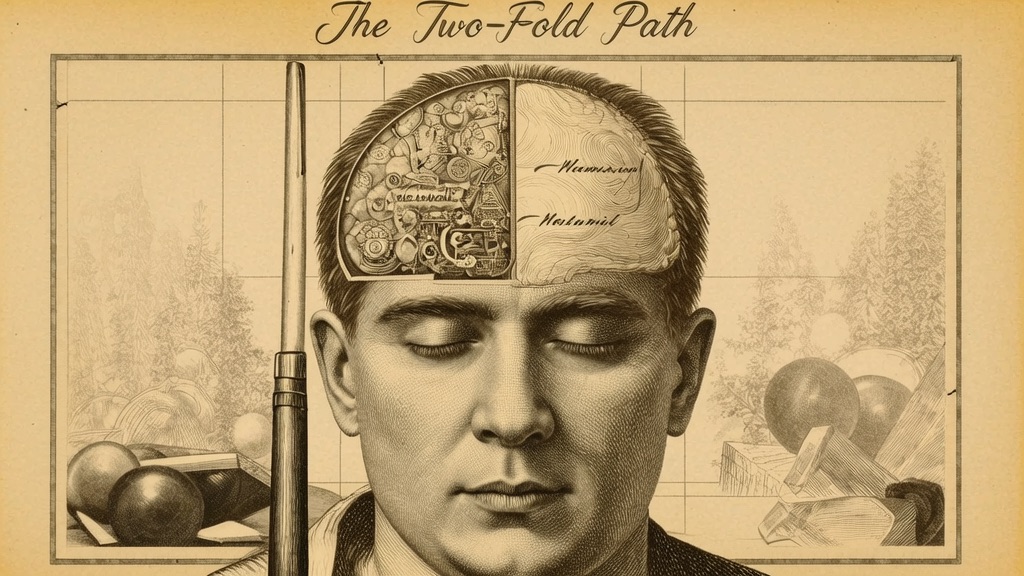
Not all players who reach the natural stage are playing the same game. There are, broadly speaking, two distinct paths. And the difference between them is the difference between a player who can compete and a player who can win under real pressure.
Mechanically Natural
These players have developed a highly specific, refined mechanical approach that works. Their stance is precise. Their routine is locked in. They play well — often at a very high level. John Higgins. Mark Selby. Neil Robertson. These are exceptional players, and nothing I’m about to say takes away from their achievements.
But here’s the distinction: their game is still, in some sense, in front of mind. They’ve rehearsed their mechanics so thoroughly that it feels natural, but if you were to change something fundamental — a new cue, a different table, a physical shift — they’d need time to re-adjust. Their natural state is built on their mechanical state. It’s mechanical, perfected.
There is absolutely nothing wrong with this. You can win world titles on this path. Many have.
Natural Natural
But the truly special players — the ones who seem to exist on a different plane — are the natural naturals. These are players who have pushed through and past the mechanical stage to the point where their technique is no longer a conscious consideration. Their mind is clear when they play. They don’t think about their cue action. They don’t think about their stance. They feel the shot, and the body follows.
And that clear mind? That’s the key to everything.
Snooker is a physical game. It’s a mental game. But more than both of those, snooker is a pressure game. Like most solo sports — golf, darts, shooting — what separates the professionals from the amateurs isn’t talent or technique. It’s the ability to perform when the pressure is on. When the frame is on the line. When the crowd is watching. When it matters.
A clear mind handles pressure. A mechanical mind — no matter how refined — will eventually crack under enough of it. The player who is still thinking about their cue action in a deciding frame is the player who misses the pink.
The Tinkering Trap
Now, here’s where a lot of competitive players go wrong.
They reach the natural stage. Things are going well. Then something changes — maybe they get a new cue, maybe they have a shoulder injury, maybe their eyesight shifts — and suddenly the shots aren’t falling like they used to. So what do they do? They go back to mechanical. They start tinkering.
And that’s fine. Tinkering is necessary. When something changes, you should go back to the mechanical stage and work through the issue. Study the change. Adjust. Rebuild.
The problem is that some players get stuck there.
They start enjoying the tinkering. They start seeing technical adjustments as the answer to every problem. They become stance and cue action obsessives — constantly fiddling, constantly adjusting, constantly searching. And they never find their way back to natural.
I call this being “lost in outer space.” The mechanical stage is a tool, not a home. It’s where you go to fix things, not where you go to play. The destination is always flow, and true flow only exists in the natural stage.
If you’re someone who is constantly tinkering — constantly changing your stance, your cue, your grip, your routine — ask yourself honestly: is this fixing my game, or is this avoiding the harder work of letting go?
There’s nothing wrong with tinkering if that’s what you love. Some players play the game to tinker. It’s their joy, their process, their meditation. And that’s completely valid. But if your goal is to compete, to win, to play at the highest level — tinkering is not the end game. It’s the repair shop. You go in, you fix what’s broken, and you get back on the table.
The Hendry Problem
Let me come back to Stephen Hendry, because his situation is a perfect illustration of everything I’ve just described.
Hendry is, unequivocally, a natural natural player. Look at how he played at his peak. Look at the speed of his game, the decisiveness, the freedom. He wasn’t thinking about mechanics. He was seeing shots. He was flowing.
And here’s the thing that tells you everything about what kind of player he is: he lost his cue. The cue he played with for years — the one his body, his hands, his feel had completely internalized — is gone. And for a natural natural player, that’s devastating. Not because a new cue can’t work, but because the relationship between a flow player and their cue is deeply physical and intuitive. It’s not about specs. It’s about feel.
So what does Hendry need to do? He has two options:
- Find a cue that’s as close as possible to his old one and get back to playing naturally as quickly as possible. Stop analyzing. Start hitting balls. Let the feel come back.
- Re-learn the nuances of a new cue from scratch — but not by overhauling his technique. By spending time at the table, playing freely, letting his body figure out the new instrument while his mind stays out of the way.
What he does not need is someone pulling him deeper into mechanical thinking. He doesn’t need to rebuild his stance. He doesn’t need to re-engineer his cue action. He needs to play.
The Ronnie Exception
Every framework has its outliers, and in this case, it’s Ronnie O’Sullivan.
Ronnie looks like a natural natural player. And he is — when he’s at the table, his mind is clear, his game is instinctive, he flows. But here’s what makes Ronnie unique: he is the only player on tour who can change his cue every season and keep winning.
Why?
Because Ronnie understands the relationship between tinkering and flow better than anyone. He studies the game obsessively — not just his own game, but the mechanics of the cue, the physics of the ball, the feel of different woods. He knows how to tinker. He uses the mechanical stage as a tool, goes in, learns what he needs, and comes back out. He doesn’t live there.
Most players can’t do this. They go into mechanical and they can’t get back out. Ronnie can. That’s not just talent — that’s deep self-awareness and an understanding of these stages that goes beyond theory. He knows when he’s tinkering, he knows why he’s tinkering, and he knows when to stop.
If you want to study someone who masters both paths, study Ronnie. But be honest with yourself about whether you have the self-awareness to do what he does. Most players don’t — and there’s no shame in that.
Know Where You Are
Here’s what I want you to take away from all of this.
First: Understand which stage you’re in right now. Are you in mechanical? Are you in natural? Have you been tinkering for months and wondering why your game isn’t improving? Be honest.
Second: If you’re in the natural stage, understand which type of natural you are. Are you mechanically natural — relying on a precise, rehearsed routine? Or are you natural natural — playing with a clear mind and genuine flow? Neither is wrong, but they require different approaches when things go sideways.
Third: If something has changed — a new cue, a physical change, a confidence issue — know that going back to mechanical is okay. It’s necessary. But set yourself a clear objective: go in, fix the issue, and get back to natural. Don’t stay in the repair shop.
Fourth: Pressure is the real test. If you can perform under pressure, you’re in the right place. If you can’t, look at your mind. Are you thinking about your technique when it matters? If so, you’re not in natural yet — no matter how good you look in practice.
Want to Find Out Where You Stand?
If any of this resonates — if you’re a competitive player and you’re not sure which stage you’re in, or you suspect you’ve been stuck in mechanical too long — I’d like to help.
I offer one-on-one assessments where we look at your game, your approach, and your mindset. We’ll figure out exactly where you are in this framework and what you need to do to move forward.
Comments
No comments yet. Be the first!
Leave a Comment