Watch this.
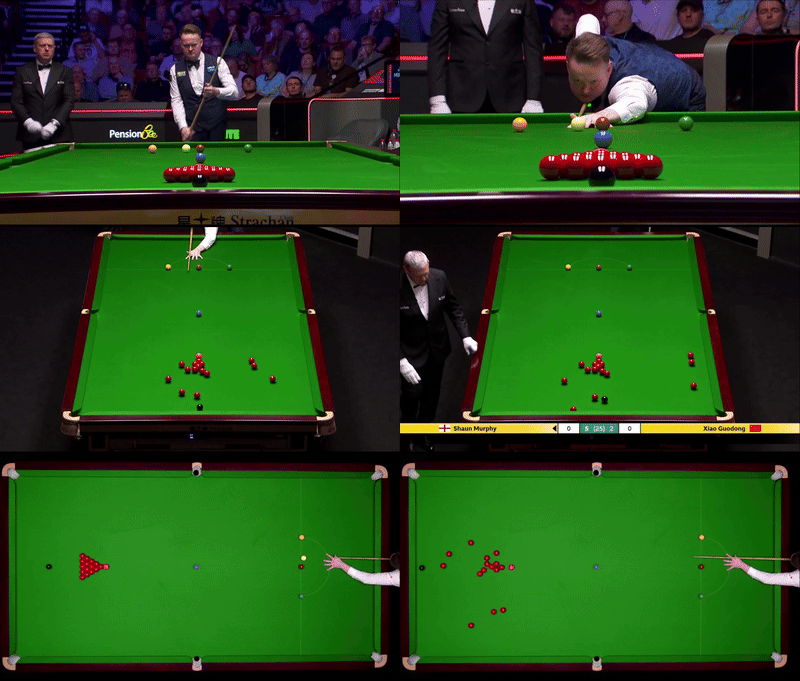
Most people will see this and move on. Shaun Murphy scratched off the break. So what? These things happen. Shrug it off. Next frame.
But if you understand what I’m about to explain, you won’t move on. You’ll watch it again. And again. Because what you’re looking at isn’t what you think it is.
The standard explanation — random deflection, bad luck, freak bounce — is wrong. What happened here is the direct, predictable consequence of something Shaun did — or more precisely, something he didn’t do — at the moment the tip met the cue ball. And it’s the same thing that affects every shot you’ve ever played, whether you noticed it or not.
Let me show you why.
Everyone in snooker is obsessed with the line.
Your stance. Your feet. Your hips. Your grip. Your elbow. Your eyes. The cue itself. The tip. Where you’re sighting. Where the cue sits under your chin. The alignment from your back foot through to your bridge hand.
And look — that stuff matters. I’m not dismissing it. If your body is out of alignment, everything downstream suffers. I’ve spent years coaching players through stance corrections, grip adjustments, and pre-shot routines. The lineup is real, and it’s important.
But there’s something happening at the very end of the stroke that almost nobody talks about. Something that separates a good cue action from a great one. Something that’s almost impossible to teach in the traditional sense because it lives almost entirely in the realm of feel.
I call it tip sense. Some people might call it tip pressure or tip torque. But those words describe the mechanics of it — the physics of contact, the force through the tip. What I’m really talking about is something broader. It’s the feeling you get. The one you can feel but can’t quite describe in certain terms. You know when it’s there. You know when it’s missing. But if someone asks you to explain it, you can’t. Not really.
Let me try anyway.
What Is Tip Sense?
Tip sense is the awareness of what happens in the last inch of your delivery. It’s the feeling — the sense — of the final transaction between your hand, the cue, the tip, and the cue ball. It’s not about how hard you hit. It’s not about power. It’s about the quality of the contact, and more importantly, your ability to feel that quality.
When people talk about “tip pressure” or “tip torque,” they’re describing the physical side of it — the force, the spin, the follow-through. Those are real things. Measurable things. But the thing that actually matters is whether you can feel them. Whether your hand knows the difference between a full contact and a shallow one. Whether the nerve endings in your fingers are sending you information that your conscious mind hasn’t caught up to yet.
Think of it this way. You can push a door open, or you can shove it open. Both will open the door. But the way it swings, the way it moves, the way it feels — that’s entirely different. And the difference isn’t cosmetic. It changes what happens on the other side.
In snooker, “the other side” is the cue ball. And what happens to the cue ball in the first few inches after contact determines everything — the spin, the trajectory, the speed, the reaction off the object ball, and ultimately, where the cue ball ends up for the next shot.
Two players can have identical stances, identical grips, identical cue actions on paper. One of them gets perfect position. The other is forever fighting the cue ball. And if you watch closely — really closely — the difference often comes down to that last inch. To the tip sense. One player’s hand is telling them something. The other’s isn’t.
Slap vs. Punch
The best analogy I’ve found for this comes from boxing.
There are two types of punchers. Some fighters slap their punches. The hand travels fast, the surface contact is brief and flat, and the impact disperses quickly. It stings. It scores points. But it doesn’t stop anyone.
Other fighters punch through the target. Their hand drives forward, the wrist stays firm, and the force transfers deep into whatever they’re hitting. The punch lands, and then there’s more behind it. It follows through. It’s the difference between a jab and a cross. Between touching the opponent and hurting them.
Snooker has the same distinction. Some players slap the cue ball. The contact is quick and flat. The cue ball goes where it’s aimed — mostly — but the energy transfer is shallow. The spin is inconsistent. The cue ball seems to “skid” off the tip rather than being sent by it.
Other players punch through the ball. The cue drives forward with purpose. The tip holds the cue ball for a fraction of a moment longer. The energy transfers fully. And you can feel it — there’s a completeness to the contact that tells you, before the ball even reaches the object ball, that the position is right.
I’ve watched players at every level. Club players, county players, professionals. And I can tell you that this distinction — slap versus punch, shallow contact versus full transfer — is one of the biggest differentiators in quality. Not stance. Not grip. Not the cue. The stroke.
Back to Murphy
Now let’s come back to that clip at the top. Watch it again if you need to.
Shaun Murphy is a world-class player. A world champion. One of the most technically sound players on tour. His stance is textbook. His cue action is smooth. By every mechanical measure, he’s doing everything right.
And yet — the cue ball scratches off the break.
The 99% response is predictable: he aimed at the wrong ball. He hit it too thin. He misjudged the angle. Sloppy cue action. Random error. And look — I’d need to watch how Shaun normally aims his breaks on the right side of the pack to be certain about his specific intention here. But I can tell you something that most viewers don’t understand about the break, and it changes the entire conversation.
Every good player who breaks to the right of the brown — as Shaun did here — knows that the cue ball will throw left on impact. The cue ball doesn’t travel in a perfectly straight line when it hits an off-center target at speed. Physics dictates that the ball will deflect. So what does every competent breaker do? They aim to the right of where they actually expect the cue ball to hit the pack. They’re compensating for throw before they’ve even hit the ball. They’re aiming at empty space, knowing the physics will bring the cue ball to the right place.
How much do they compensate? That depends on the player, the cue, the tip, the speed, and — critically — the tip pressure. Because here’s the thing: the amount of throw isn’t fixed. It changes based on how you strike the cue ball. A shot with good tip pressure — one that drives through the ball with proper spin and follow-through — will throw differently than a slapped shot. The spin you impart affects how the cue ball interacts with the first ball it contacts. Different spin, different throw, different result.
This is why the break is actually one of the best exercises for developing your tip sense. The effects of off-center strikes compound on the break. On a normal shot, a slight miscalculation in throw might cost you a fraction of position. On the break, that same miscalculation cascades. The cue ball’s trajectory off the pack determines where it hits the cushions on the next three or four cushion contacts — and those contacts determine where the cue ball ends up. Get the first one wrong and the rest follow.
Think about it this way: when I ask you to break and land the cue ball on the brown — what do you do? You probably hit harder. You probably adjust your aim. But here’s what most players don’t consciously do: they adjust their tip pressure. They’re trying to control the throw by changing the speed, but the real variable is the quality of the contact. Hit with the right tip pressure, and the throw is predictable. Hit with the wrong tip pressure — slap the ball instead of punching it — and the throw becomes unpredictable. The cue ball goes somewhere you didn’t intend. Sometimes into a pocket.
I’m assuming, by the way, that you hit with side on the break. I assume you do. Most players I know do. Side changes the equation further — it affects the throw, the rebound, and the cue ball’s behavior after contact with the pack. And the amount of side you actually get is directly related to tip pressure. Slap the ball with side and you’ll get less than you think. Punch through with side and the spin takes hold immediately. Same aim, same speed, completely different result.
So here’s a good exercise. Next time you’re practicing breaks, pay attention to three things:
- Where are you aiming? Right of pack? At the last ball? How much compensation are you building in for throw?
- How much throw do you expect? One ball? Two balls? What happens if I change nothing about your aim but ask you to change the tip pressure — drive through more, or hit flatter? Does the throw change?
- What happens when you change speed? Do you adjust aim to compensate for speed, or do you adjust tip pressure? Most players change aim. Better players change pressure.
The break is an incredibly honest exercise. It compounds every error and every strength. And tip sense — the thing nobody looks at — is what controls the outcome more than anything else.
Now let’s come back to Murphy. Watch that break again. The contact was flatter than it should have been. More of a slap than a punch. The cue ball didn’t carry the controlled spin that a properly torqued break produces. It skidded off the tip, lost its rotation, and the throw went somewhere Shaun didn’t intend — into the pocket.
This is the thing that 99% of viewers will miss. They’ll see the result and attribute it to chance. But the result was caused by the delivery. The tip didn’t drive through the cue ball the way it needed to. The energy transfer was shallow. The throw was unpredictable. And the in-off was the natural, predictable consequence.
Not unlucky. Under-torqued.
Why Nobody Talks About It
So if tip sense is this important, why doesn’t every coach teach it?
Because it’s hard.
It’s hard to see. From the outside, a slap and a punch can look almost identical. The stroke path is the same. The backswing is the same. The follow-through length might even be the same. The difference is happening at the molecular level — it’s in how the hand decelerates or drives through at the moment of contact. It’s in the tension or relaxation of the fingers. It’s in the timing of the wrist.
It’s hard to describe. I’ve been coaching for a long time, and even now, putting this into words feels imprecise. When I try to explain tip sense to a student, I often resort to demonstration — hitting balls and saying “feel that? Now feel this.” The difference is real, but it resists language.
It’s hard to teach. You can tell someone to “follow through” all day long. You can put a bottle behind the cue ball and tell them to hit through it. You can show them slow-motion video. But the follow-through is an effect, not a cause. Players who drive through the ball will naturally follow through. Players who slap the ball will follow through because you told them to, but the underlying contact hasn’t changed. You’ve taught them to extend the follow-through without changing the thing that matters — the delivery itself.
And honestly? I think most coaches don’t talk about it because they haven’t consciously identified it in their own game. Tip sense is one of those things that good players do naturally but can’t always explain. They’ll tell you to “feel the shot” or “stay smooth” or “don’t jab at it.” All useful advice, but none of it gets to the heart of what’s actually happening at the tip.
But there’s a deeper problem here. And it’s the one that makes this genuinely difficult to teach.
The Problem With Feel
Here’s something I want to be completely honest about: every single player who has ever picked up a cue knows what I’m talking about. They’ve felt it. That moment where the cue ball “just goes.” Where the contact is clean, the spin is exactly what you intended, and the cue ball rolls to exactly where you wanted it. They’ve felt the opposite too — the jab, the slap, the feeling of the ball running away from the tip before the energy has fully transferred.
Every player has felt tip sense. But here’s the thing: every player has only felt their own version of it.
I can’t show you what tip sense feels like to Ronnie O’Sullivan. I can’t show you what Marco Fu’s delivery feels like at the moment of contact. I can’t put Judd Trump’s hand sensation into your hand. Even if I set up a slow-motion camera — pointed directly at the tip, frame by frame — and showed you exactly what their tip does at the moment of contact, I still couldn’t show you what it feels like. I could show you the mechanics of it. The deflection of the leather. The duration of contact. But the feel? The intent? The thing that actually matters?
That’s locked inside their hand.
It’s like trying to explain what timing feels like in tennis. Any tennis coach can tell you that timing is about meeting the ball at the right moment with the right racket speed. They can describe it, demonstrate it, show you slow-motion footage of Federer’s forehand. But either you feel the timing or you don’t. You can’t think your way into it. You can only hit enough balls that your body finds it.
Snooker is the same, but more so. Because the “ball” in snooker is a 1.5-inch sphere of phenolic resin, and the “racket” is a leather tip on the end of a wooden shaft, and the entire transaction happens in a space so small you can barely see it. The feel is in your hand. Literally in the nerve endings of your fingers, the tension in your wrist, the timing of your delivery. And every hand is different.
So what does this mean? Do some people have better hand-eye coordination than others? Do some have more sensitive nerve endings in their fingers? Are some hands better suited to this game than others?
I don’t have a good answer. I wish I did. What I can tell you is that I’ve seen players with identical training, identical coaching, identical practice hours — and one of them develops tip sense naturally while the other fights for it their entire career. The mechanics look the same. The practice is the same. But the feel is different.
All I can do is explain what it is. I can describe the markers. I can give you the framework. I can point you toward it. But I can’t put it in your hand. That part — the finding of it — is yours.
The Martial Arts Parallel
I’ve trained in martial arts, and the parallel here is exact.
In striking arts — boxing, Muay Thai, karate — there’s a concept that every practitioner eventually encounters. You can learn the form perfectly. Your stance is textbook. Your technique is correct. But the first time you really hit something — a heavy bag, a pad, a sparring partner — you realize that the technique is only half the equation.
The other half is intent. It’s the decision to drive through the target rather than to the target. It’s what martial artists mean when they say “punch through the board, not at the board.” The physics are the same — same fist, same arm, same speed. But the result is completely different because the intent changes how your body delivers the force at the moment of impact.
Snooker is the same. You can have perfect mechanics and poor intent. You can have a textbook cue action that delivers a slap instead of a punch. And you’ll never quite understand why your positional play is inconsistent because from the outside, everything looks right.
The answer is in the last inch. In the intent. In the tip sense.
What Good Tip Sense Feels Like
I want to be honest: I can’t fully describe this. But I can give you markers.
When you strike the cue ball with good tip pressure, the contact feels complete. There’s no sense of the ball escaping the tip prematurely. There’s no sense of the tip bouncing off the ball. Instead, the tip seems to stay with the ball for just a moment — long enough to transfer everything, and then the ball is gone.
Your hand feels like it’s pushing something forward, not hitting something away from you. The cue doesn’t stop at the ball — it continues through, as if the ball were never there. And the cue ball itself seems to move with more authority. It rolls with purpose. The spin takes hold immediately. It doesn’t skid, doesn’t wobble, doesn’t drift.
After the shot, there’s often a feeling of quiet in the hand. No tension, no jarring, no residual energy. The stroke has been fully spent. It’s gone somewhere — into the ball. That’s how you know.
Compare that to a slap. After a slapped shot, you’ll often feel a slight vibration in the hand. A buzz. That’s energy that didn’t transfer — it bounced back. The cue ball will look fine off the object ball, but it’ll be slightly off position. A fraction too fast or too slow. A fraction too much or too little spin. And over a frame, those fractions add up.
The Light Cue Ball
Let me give you proof that this feel is real. Not theory. Not coaching philosophy. Something you’ve experienced. Maybe more than once.
You’re playing a match. It’s been hours. Nothing feels right. Shots you’d normally make are sliding off. Position is a fraction out. You’re fighting the cue ball on every shot. You check your tip. You try a different cue. You blame the cloth, the temperature, the humidity. You’re doing everything the same as always, but something is off. You can feel it — or more precisely, you can feel that something is missing.
Then someone changes the ball set. And suddenly — everything is heavy again. The contact feels right. The cue ball rolls with authority. The position falls. The frame clears.
What happened?
You were playing with a light cue ball. Not light enough to notice by picking it up. Not light enough for the scales to flag. But light enough that your hand knew. Every single shot you played for the last hour, your tip was telling you something was wrong. The contact felt empty. The energy transfer was off by a fraction. The ball wasn’t there the way it should have been.
And you didn’t consciously know until you changed the set.
That’s tip sense. That’s the thing I’m talking about. Your hand — your fingers, your wrist, the nerve endings in the last inch of your delivery — detected a weight difference in a 1.5-inch ball through a leather tip on the end of a wooden shaft. Before you knew it. Before you could name it. Before you could point to it and say “the cue ball is light.” Your body already knew. It had been telling you the whole time.
This is why tip sense matters. Not because a coach told you it matters. Not because I wrote a blog post about it. Because your hand already knows. It already feels the difference between a good contact and a bad one, between a full transfer and a shallow one, between a punch and a slap. The question is whether your mind is paying attention.
Why This Matters Under Pressure
Here’s where this connects to the competitive game.
When you’re under pressure — deciding frame, tight clearance, crowd watching — your body does something predictable. It tightens. The grip gets firmer. The stroke gets shorter. The follow-through gets cut off.
For a player who relies on mechanical precision, this tightening is devastating. Their game is built on doing the same thing every time, and now their body is doing something different. The shots start to miss. The position starts to drift. And the more they miss, the more they tighten, and the spiral continues.
But a player with good tip sense has a different relationship with pressure. Because their stroke is driven by feel — by intent — rather than by mechanical repetition, they have something to hold onto when the body tightens. They can tighten the grip slightly and still maintain the quality of the contact. The intent survives even when the mechanics wobble.
This is why some players seem to play better under pressure and others crumble. It’s not mental toughness — or at least, not only. It’s that the players who crumble are relying on mechanics that break down under stress. The players who thrive are relying on something deeper. A feel for the ball. An intent in the delivery. Tip sense.
How to Develop It
I wish I could give you a drill. I wish I could say “do this exercise for 20 minutes a day and your tip sense will improve.” But the truth is more nuanced than that.
Equipment: The Layered Tip Advantage
One thing that is genuinely helping players develop better tip sense is the move to layered tips. Tips like Kamui, Taom, and others use a layered construction — multiple sheets of pressed leather — that gives a more consistent contact surface. The tip holds its shape better. It grips the cue ball more predictably. And critically, it transfers the energy more reliably.
Why does this matter for tip sense? Because a layered tip removes some of the inconsistency from the equation. With a traditional single-piece tip, the contact surface can vary depending on how the tip has been shaped, how much chalk is on it, how worn it is. A layered tip gives you a more stable platform — and a more stable platform means the feedback you get from each shot is more consistent. You start to feel the difference between a slap and a punch more clearly, because the tip isn’t introducing its own variability on top of yours.
I’m not saying a layered tip will teach you tip sense. It won’t. But it’s like putting good tires on a car — it doesn’t make you a better driver, but it gives you more information about what the road is doing. And when you’re trying to develop feel, information matters.
That said — and I want to be clear about this — the tip is not the answer. Some players switch to a layered tip and immediately feel an improvement, then assume the tip was the problem. It wasn’t. The tip was masking the problem. The underlying delivery is still the thing. If you’re slapping the ball, a better tip will give you a more consistent slap. It won’t turn it into a punch.
The Attention Drill
Beyond equipment, the best thing you can do is start paying attention to the contact. Not the result — the contact. When you strike the cue ball, what does it feel like? Is there a completeness to it? Or is there a buzz, a bounce, a sense of something unfinished?
Hit balls slowly. Not slow in speed — slow in attention. Pay attention to what your hand is doing in the last inch of the stroke. Are you pushing through, or are you stopping at the ball? Is the cue accelerating at the moment of contact, or is it already decelerating?
Try this: set up a simple straight pot into a center pocket. Pot it twenty times. On the first ten, just pot it — don’t think about anything. On the next ten, focus entirely on the feeling of the tip staying with the cue ball for a fraction longer. Don’t change your stance. Don’t change your grip. Don’t change your backswing. Just change the intent. Drive through the ball.
Notice the difference in how the cue ball rolls. Notice the difference in how your hand feels after the shot. That’s the difference between a slap and a punch. Between shallow contact and full contact. Between a stroke that sends the ball and a stroke that just… hits it.
The Part Nobody Sees
Snooker is a game of millimeters. Positional play — getting the cue ball to the right place for the next shot — is what separates good players from great ones. And positional play isn’t just about knowing where to go. It’s about being able to get there. Consistently. Under pressure. Without thinking.
That consistency doesn’t come from your stance. It doesn’t come from your cue. It doesn’t come from your grip or your alignment or your pre-shot routine.
It comes from the stroke. Specifically, it comes from the last inch of the stroke. From the tip sense. From the quality of the contact between tip and cue ball.
Everyone looks at the line. Nobody looks at this. And this is where the game is really played.
Watch that Murphy clip one more time. Now you know what you’re looking at.
Comments
No comments yet. Be the first!
Leave a Comment