Here’s the most common piece of snooker advice in the world: find the contact point.
Draw a line from the center of the pocket through the center of the object ball. Where that line meets the surface of the ball — that’s your contact point. Aim the cue ball there. Job done.
And look — it’s not wrong. It’s technically correct. Every pot has a specific point on the object ball that sends it into the pocket. No argument there.
But here’s the thing nobody says out loud: the contact point is not your problem.
You already know where to hit the ball. Even a novice, standing behind the shot, can visualize the contact point. Your brain is remarkably good at this — given a clear view of the pocket, the object ball, and the cue ball, it calculates the geometry almost instantly. You’ve been doing it since your first week at the table. After a few years, you don’t even think about it. You just see the shot.
So why do you still miss?
The Real Problem
You miss because your cue isn’t on the shot line. And the terrifying part — the part that makes this so difficult to fix — is that you can’t tell.
Stand behind a shot. Look down the line from cue ball to object ball. You can see it clearly. The angle, the contact point, the path the cue ball needs to travel. It’s obvious. Your brain has no trouble processing it from this vantage point.
Now get down on the shot.
Something happens between standing and being down that almost nobody talks about. From your address position — chin on the cue, eyes locked on the object ball — you believe you’re on the shot line. Everything looks right. Your cue appears to be pointing exactly where it needs to go. You pull back, deliver, and… miss. By a hair. By half a ball. By enough to know something was wrong but not enough to know what.
Here’s what happened: you were never on the line in the first place. You thought you were. Your eyes told you that you were. But your eyes lied.
Players miss shots for all kinds of reasons — bad cueing, poor shot choice, mental pressure, awkward bridges, bad equipment, unfamiliar conditions. All of these are real. But one of the most common causes — and one of the least talked about — is the player aiming at the correct contact point from an incorrect position. The aiming is fine. The delivery is fine. The alignment is off. And once you’re down, you have almost no way of knowing.
Why Your Eyes Lie
This is where eye dominance enters the picture.
Most people have a dominant eye — one eye that your brain trusts more than the other for spatial judgment. You might be right-eye dominant or left-eye dominant, and it doesn’t necessarily match your handedness. A right-handed player can easily be left-eye dominant, and vice versa.
Here’s why this matters in snooker. When you’re standing behind the shot, both eyes are working together, roughly equidistant from the shot line. Your brain builds an accurate picture of the geometry. But when you get down on the cue — when your head drops close to the shaft and one eye is necessarily closer to the cue line than the other — your dominant eye takes over. It becomes the primary input for your spatial awareness.
If your dominant eye isn’t directly over the cue, your perception of “straight” shifts. Not by a lot. Not by anything you’d consciously notice. But by enough. A degree or two. Maybe three. Enough to miss a long pot. Enough to miss a thin cut. Enough to clip the wrong edge of a ball and wonder what happened.
The cruelty of it is that it feels correct. Your brain isn’t sending you an error signal. It’s telling you the cue is on line. It genuinely believes that. Because from the perspective of your dominant eye — which is slightly off-center — the cue does appear to be on line. The distortion is invisible from the inside.
This is why some players can pot everything in practice — where they’re relaxed and their head position is consistent — but miss under pressure when their head lifts even a fraction. It’s why some players are deadly accurate on one side of the table but inconsistent on the other. It’s why you can set up the same shot ten times, feel like you’re doing the same thing every time, and miss three of them for no apparent reason.
The reason is often the same: you weren’t on line. And you couldn’t tell.
The Mechanical Chain
Let me break down exactly how misalignment happens during the walk-in. Understanding this is the first step to fixing it.
When you stand behind a shot, your head is roughly behind the shot line — the line the cue ball needs to travel along. Good. But your feet are on either side of that line. They have to be. You’re a human being, not a monorail. Your body has width.
Now you begin to get down. For a right-handed player, the right foot typically drops forward and into the shot line. Your body lowers. Your head comes down toward the cue.
Here’s where it goes wrong. Your cue needs to arrive on the shot line. But your cue is connected to your cueing hand, which is connected to your arm, which is connected to your shoulder, which is connected to the rest of your body — which started with its feet on either side of the line. The cue often arrives late to the shot line. It comes in from the side — usually the right side for a right-handed player — and settles somewhere close to the line but not quite on it.
Your cueing hand doesn’t drop cleanly onto the shot line. It drops near the shot line. And “near” is not “on.”
And then — this is the key — once you’re down, eye dominance kicks in. Your brain looks through your dominant eye, sees the cue, and tells you: yep, that’s straight. But it isn’t. You’re off by a fraction. A degree or two. And from this position, there is no internal signal telling you otherwise.
This is why so many players have unconsciously developed compensating habits. They use side spin to “throw” the object ball into the pocket. They steer the cue during delivery. They develop a slight body movement — a sway — that brings the cue onto line at the last moment. These aren’t cue action faults in the traditional sense. They’re unconscious corrections for a misalignment the player doesn’t even know exists.
You might have been doing this your entire playing life without realizing it.
Why Contact Points Are a Dead End
So when a coach tells you to “find the contact point” — what are they actually solving? Nothing. You already know the contact point. You’ve known it since you were a month into this game. The contact point on a half-ball pot doesn’t change. The contact point on a thin cut doesn’t change. These are geometric facts that your brain internalized years ago through repetition and practice.
The issue was never knowing where to aim. The issue is delivering the cue to that point from a position that’s actually on line.
Teaching contact points to a player who’s misaligned is like giving someone a perfect map and then blindfolding them. The map is correct. The destination is clear. But they’re walking in the wrong direction and they can’t see it.
I’ve watched players spend months drilling contact point exercises — visualizing the ghost ball, projecting lines, doing half-ball drills — and improving only marginally. Because the problem was never their understanding of the aim. It was their alignment going in. Fix the alignment, and the contact points you already know start working. Immediately.
Here’s a video that explains the contact point method well. It’s solid, and the technique is sound. But watch it with the understanding that none of it works if your cue isn’t on the shot line when you deliver:
The method in that video becomes powerful — genuinely useful — once your alignment is sorted. But if you’re offline by two degrees, it doesn’t matter how precisely you’ve identified the contact point. You’re going to miss. And you’re going to think you aimed wrong, when actually you aimed perfectly from the wrong position.
Billiards is very often an alignment problem. Not cue action, not contact point identification, but alignment. Precise alignment that you can consistently reproduce over and over.
Every Pro Has a System
No professional player gets down on the shot randomly. They all have a system — a repeatable sequence of movements that gets their cue onto the shot line before they commit to the stroke. Some are obvious. Some are subtle. Some the player themselves might not even be fully conscious of.
Stephen Hendry — arguably the greatest potter the game has ever seen — had a distinctive head tilt before getting down. Watch old footage carefully. Just before he lowers into his stance, his head tilts slightly to the right. It’s subtle. You’d miss it if you weren’t looking for it. But that small movement brought his head over his cueing hand — over the cue line — before he went down. Whether he developed this consciously or it emerged naturally through thousands of hours of practice, I don’t know. But it’s his system. And today, when his cueing looks less consistent than it once was, I’d argue it’s because that small pre-correction has drifted. The system has lost its calibration.
Shaun Murphy is more explicit. Watch him address a shot. His right foot is already forward. His cue butt is over his right foot when he’s standing and he is holding the cue across his body before he gets down into position. Before he even begins to lower himself, his cue butt and right foot are on the shot line. He’s solving the alignment problem from the very first moment. His system is: get the cue butt and the right foot on line before anything else happens.
Ronnie O’Sullivan is perhaps the most classically aligned player on tour. He walks into the shot line naturally. His head, his cue, and his body arrive together. He cues in a straight line. It’s textbook — and it’s why his potting is so effortless. Though interestingly, he often cues over his left eye rather than his right. If he’s left-eye dominant — which is entirely possible for a right-handed player — this would put his dominant eye directly on the cue line. His own quiet solution to the same problem everyone faces.
Judd Trump is an anomaly. Watch him feather the cue ball. The cue is often visibly off-line during his preliminary strokes. He appears to be sighting from a position that isn’t quite on the shot line. But on the final delivery — the actual strike — the cue arrives. He times his alignment correction into the stroke itself. It’s extraordinary and almost certainly not something you’d want to copy. It works for him because he’s Judd Trump and he’s done it ten million times. But it explains why even a player of his caliber can be inconsistent. His margin for error is razor-thin because the correction is happening at the last possible moment.
The point is: every player has their own approach to getting down “in line.” The players who have a conscious, repeatable system tend to be more consistent. The players who don’t — who just walk in and hope for the best — tend to rely on unconscious compensations. Side spin. Steering. Body sway. These compensations work often enough to mask the problem. But they break down under pressure, on unfamiliar tables, and on the shots where millimeters matter most.
No One Is Perfect
I want to be clear: no player is online 100% of the time. It’s impossible. The variables are too numerous.
Sometimes the cue ball is on the cushion and your bridge is compromised. Sometimes you’re bridging over a ball and your entire body geometry changes. Sometimes you’re on the rest and your cueing hand isn’t even involved. Sometimes the angle requires you to stretch, and your head can’t get where it normally sits.
There are perhaps hundreds of possible scenarios that change your alignment equation. Each one requires a slight adjustment to your system. Approaching 100% accuracy requires intense study of every possible scenario — and even then, the best players in the world still miss by a hair on occasion.
That “hair” — the shot that just catches the jaw, that slides past by a fraction — that’s not bad luck. That’s the player being a degree offline and not knowing it. Even Ronnie. Even the best who ever played. The difference is that the great players are offline less often, and by smaller margins, because their system is more refined.
The goal isn’t perfection. The goal is to get your error rate down to the point where you’re in line 99% of the time. And that’s achievable — with a system.
The Glue-the-Cue Method
Here’s what works for me. It’s what I teach, and it’s what I’d recommend as a starting point for any player who suspects their alignment is off.
The method has four components, but they happen as a single flowing movement — not a checklist you tick through one at a time. It’s one continuous action from standing to being down on the shot.
1. Stand square behind the shot line. Before anything else, position yourself behind the shot. Look down the line the cue ball needs to travel — the line that sends it to the correct contact point on the object ball, accounting for whatever english you intend to apply. This is the one moment where your alignment is most reliable, because both eyes are equidistant from the line and your brain has a clear, unbiased view of the geometry.
2. Glue the cue to your hip. Take your cue and tuck the butt into your hip. Hold it there. This is the key move. By anchoring the cue butt to your body at the hip, you’re preventing it from drifting off-line as you move into your stance. The cue stays connected to your center of mass rather than arriving independently from the side.
3. Walk into the shot line — right foot down on the line. Step forward, placing your right foot (for right-handers) directly onto the shot line. Don’t look at your foot. Feel it. You know where the line is — you were just standing behind it. Trust your body to find it. As your foot lands on the line, the cue — still glued to your hip — comes forward with you. It’s arriving on the shot line with your body rather than being swung into position separately.
4. Get down — chin as low as possible. As you lower into your stance, let the cue come off the hip and settle onto your bridge hand. Here’s the piece I added most recently, and it makes a real difference: get your chin as close to the cue as you physically can. Tilt your head just enough to see both the cue ball and the object ball without moving your head, and no more. The lower your head, the less room there is for your dominant eye to pull your perception off-center. You’re minimizing the gap between your sighting eye and the cue line, which reduces the distortion.
All of this is one movement. Stand, glue, walk, down. It takes a second and a half. Maybe two seconds. With practice, it becomes completely automatic — you don’t think about the individual pieces any more than you think about the individual muscle movements in walking.
The result: your cue butt arrives on the shot line early — before you’re down. Your right foot is on the line. Your head is low and close to the cue. The three anchoring points — foot, cue butt, and head — are all on or very near the shot line before you ever pull the cue back for a preliminary stroke.
I can consistently hit straight long pots using this approach. Not because my eyes are better than yours or my cueing is smoother. Because my cue is on the line. And once the cue is on the line, the contact points I already know start working.
Other Approaches (And Their Tradeoffs)
Some players prefer to place the cue down in front of their body before getting into their stance — laying it on the line as a visual reference. This can work, but it tends to throw off your stance because you end up walking around the cue to get into position. You solve the cue alignment problem but introduce a body alignment problem. You become “offline” again, just for a different reason.
There are also players who develop a specific pre-shot movement — like Hendry’s head tilt — that corrects their alignment at the last moment. These systems work beautifully when they’re calibrated, but they’re fragile. They rely on a very precise, small movement happening the same way every time. When form dips or confidence wavers, the correction can drift without the player noticing.
The glue-the-cue method is less elegant but more robust. It solves the problem early — getting the cue onto the line before you’re in a position where eye dominance can deceive you. It’s harder to get wrong because the correction happens while your perception is still reliable.
The Black Spot Test
Here’s how you know your system is working.
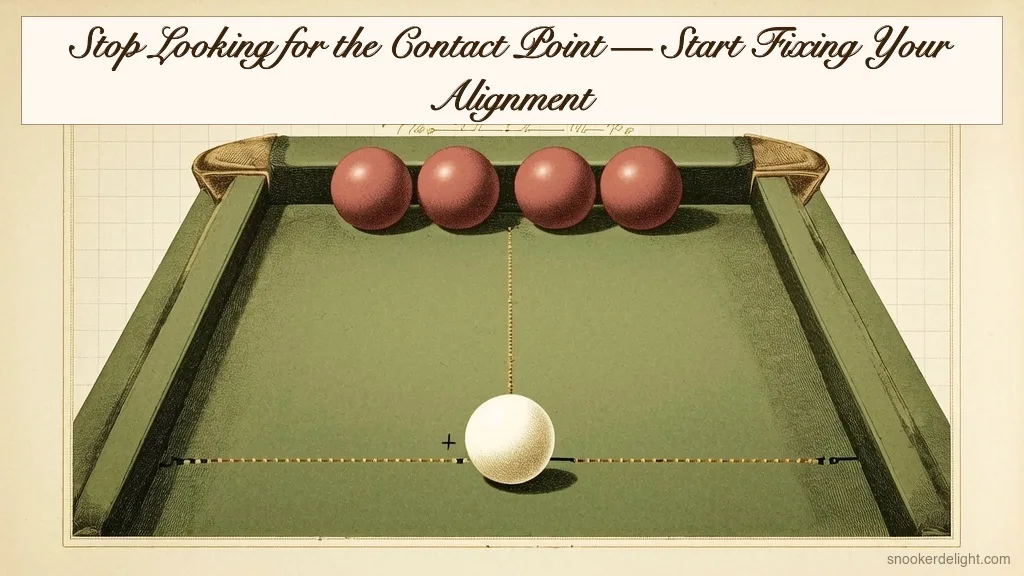
Place the cue ball about an inch in front of (or behind) the brown spot. No other balls on the table. Your target: the black spot. Hit the cue ball straight at the black spot — dead center — and stay down after the strike.
If your alignment system is working — if the entire collection of movements that get you down into position are correct — the cue ball should travel to the black spot, hit the far cushion, and come straight back to hit your cue tip. Straight there, straight back.
Simple in theory. Brutally honest in practice.
If the ball comes back and misses your cue to the left or right, you know — with absolute certainty — that you were offline. Not that you cued badly. Not that you misjudged the aim. You aimed at a spot. You have no angle to misread. The only variable is whether your cue was pointing where you thought it was pointing.
This test strips away every excuse. There’s no object ball to blame. No angle to miscalculate. No pocket to jaw. It’s just you, the cue ball, and the truth about your alignment.
To increase difficulty: Here’s how I set it up. Place four reds and a colour ball on the cushion behind the black spot. Use the colour ball to create a ball-width gap directly behind the black spot — place it between two of the reds as a spacer. Then remove the colour ball and move each of the two inner reds slightly outward — about 3-5mm each side, roughly half a cue tip width. You now have a gap just barely wide enough for the cue ball to pass through and hit the cushion cleanly.
If the cue ball passes through that gap and returns to your cue tip, your alignment is dialed in. If there’s any unintended side on the ball — even a fraction — it’ll clip a red on the way through and you’ll know immediately. Make the gaps smaller to increase the precision required.
I can do this test and get the cue ball back to my cue nearly perfectly using a few different stances I’ve developed. That’s the goal — not one rigid system, but a reliable approach to alignment that works across different shot scenarios.
This drill doesn’t teach you anything about aiming. It doesn’t improve your knowledge of angles or contact points. What it does is condition and refine your system — the walk-in, the stance, the head position, the entire chain of movements that puts your cue on the shot line. Do it regularly and your error rate drops. Your 99% consistency becomes achievable.
The Takeaway
Stop looking for the contact point. You already have it. You’ve had it for years. Your brain calculates the aim faster than any coaching manual can explain it.
What you don’t have — what almost nobody teaches — is a reliable system for getting your cue onto the shot line before you commit to the stroke. That’s the gap. That’s where the misses live. Not in your understanding of the angle, but in the physical reality of where your cue actually is when you pull the trigger.
Fix the alignment, and the contact points you already know start going in. Immediately. Without any new aiming technique. Without any new visualization method. Just your existing knowledge, delivered from the correct position.
Billiards is an alignment problem. Everything else is a red herring.
Over to You
I’m curious — what’s your system for getting down on the shot? Do you have a conscious walk-in routine, or do you just step in and hope for the best? Have you ever tested your alignment with something like the black spot drill? And if you have — did the cue ball come back straight, or did it surprise you?
Drop a comment below. I’d especially like to hear from players who’ve changed their walk-in routine and noticed an immediate difference. What did you change, and what happened?
Comments
No comments yet. Be the first!
Leave a Comment