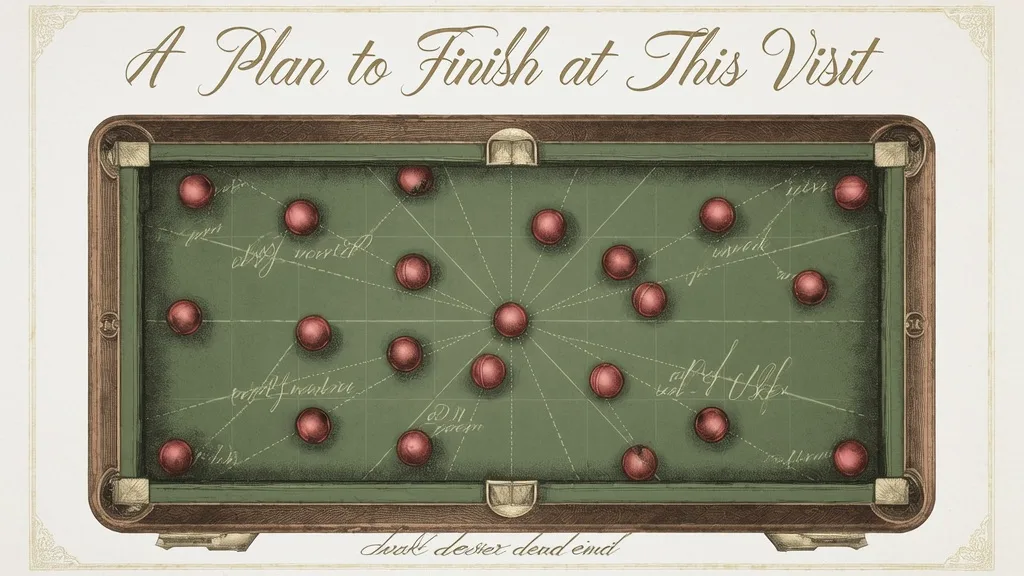
I’m watching Ding Junhui play Zhao Xintong in the 2026 World Championship. Round 2, frame 19. Zhao is up 10-8 in a best of 25, and has a 47-point lead in this frame. And something is happening that I see all the time in match play — but most people watching won’t notice it.
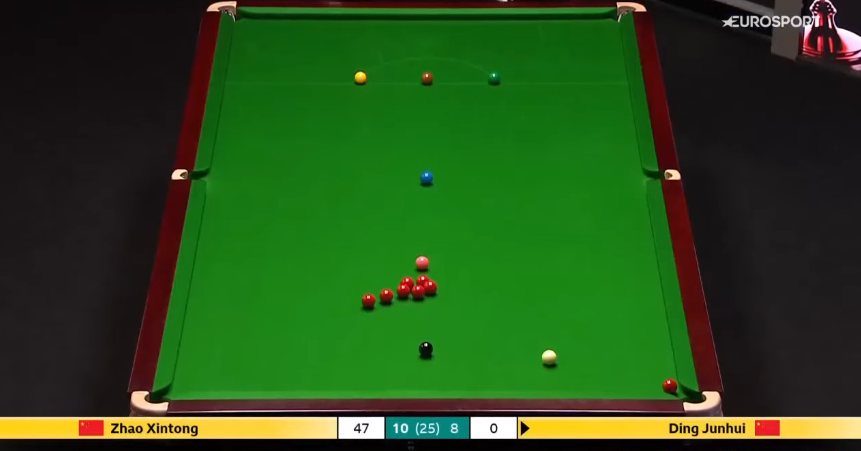
Ding had a chance. There’s a red sitting over the corner pocket. By any normal measure, this is a frame-winning opportunity. Give Ding this position a hundred times in practice and he clears up ninety of them.
But he didn’t. He made a simple mistake. Then another. The frame slipped away.
And I could see why. Not because his cue action was off. Not because the shot was too hard. But because of what was going on inside his head: he was just potting the next ball.
Just Potting the Next Ball
This is the most common failure mode in competitive snooker. You come to the table, you feel the pressure, you feel the weight of the frame — and instead of planning how to win, you start planning how to survive. You look for the easy ball. You take the comfortable route. You pot one, then look for the next easy one. You’re not building a break. You’re just staying alive.
It happens to everyone. It happens more often than anyone admits. And it’s almost invisible from the outside, because the player is still potting balls. They still look like they’re playing well. But they’re not playing to win — they’re playing not to lose. And there’s a world of difference.
Ding was doing this. I could see it in his shot selection. He was passing up the route that would win the frame in favour of the route that would keep him at the table for one more shot. Not because he couldn’t see the better path. But because his mind had narrowed. Under pressure, the brain defaults to the simplest thing in front of it. The next ball. Not the frame. The next ball.
The Cipher
Here’s how I think about snooker — and I know this sounds abstract, but stay with me.
Every frame starts the same. Fifteen reds, six colors. Same table, same positions. But from the moment the first ball is struck, the frame becomes unique. Every cue ball contact writes something new. Every pot, every safety, every miss changes the geometry. The frame develops a fingerprint that has never existed before and will never exist again.
In a way, snooker is like watching a cipher being programmed with every strike of the cue ball. The more the cue ball is struck, the more unique the cipher becomes. And as reds and colors are potted, the cipher gets deciphered. The puzzle resolves.
I know this sounds abstract. But watch any frame back and you’ll see it. The cue ball paths, the pots, the safeties — they’re writing a code that only that frame will ever have. And your job, at the table, is to read it.
The colors go back on their spots so you can navigate the reds and unlock them. Every frame is a puzzle you get the chance to solve at your visit to the table. The question is whether you’re actually trying to solve it — or just reaching for the nearest piece.
HDIWATV
How Do I Win At This Visit.
Say it to yourself every time you step to the table. Not “what’s the next easy ball?” Not “how do I stay at the table?” — How do I win at this visit?
This is the single most important question in match snooker. And it’s the one players abandon first when the pressure comes on.
HDIWATV forces you to plan the break, not just make the next ball. It forces you to look at the whole table — where the reds are, where the colors sit, what needs to be unblocked, what route gets you to the finish line. It forces you to think about getting on the blue in such a way that you can open the reds and score heavily, rather than taking the easy red on the cushion that gets you twenty points and leaves you stranded.
It also forces you to take on the difficult shot that makes the rest of the break easier. Perhaps it’s unblocking a pack of reds. Perhaps it’s removing one or two key reds that let you continue the break. The shot that looks harder is often the one that actually wins the frame — because it opens the rest of the table.
Break building, in some respect, is like a puzzle you have to decipher. It’s a code you have to break, and every single frame is different. Some patterns you and your opponent always start with — fifteen reds, six colors. But the rest evolves as the frame plays out. HDIWATV is how you read that evolution and act on it.
The Unlocker
Let me make this concrete.
You’re at the table. You just scored 8 points. Five reds left. The easy ball is the red sitting over the side — clean pot, simple position on a balk color. You pot it, make the yellow, and now you’re looking for the next easy ball. But the remaining reds are clustered near the pink and two are near the black, tangled up, and you don’t have a clean route through them from the yellow. You’ve scored eleven points. You’re probably leaving the table soon.
Now rewind. Same position. But instead of the red over the corner, you take the red near the top cushion — about five inches from the corner. It’s a harder pot. But if you drop it in, it gets you low on the black. That gets you into a spot where you can free the black up. Now there are routes everywhere. The table has unlocked.
The easy red is easy. But it’s not always the right shot.
That’s HDIWATV in action. The first red kept you alive. The second red wins the frame.
The unlocker is the shot that makes everything else possible. It’s not always the hardest shot on the table. But it’s almost never the easiest. And you will only see it if you’re looking at the whole break — if you’re asking HDIWATV instead of “what’s next?”
Pressure Kills the Plan
Back to Ding.
Why was he just potting the next ball? Because Zhao Xintong was sitting in his chair. Because Zhao is the reigning World Champion. Because Ding knows that Zhao can beat him. Because the crowd knows it too.
Pressure does that. It distracts you from what you’re meant to do. It narrows your focus to the immediate — the next ball, the next pot, the next safe shot. And the moment you lose sight of HDIWATV, you’re no longer playing to win. You’re playing to postpone losing.
This is why keeping this one idea in your mind is so important. Not five principles. Not a coaching manual. One thing: How do I win at this visit?
When the pressure comes — and it will — that question is your anchor. It pulls you back from the narrow focus of “next ball” thinking and forces you to see the whole table. It won’t make the shots easier. But it will make sure you’re taking the right shots.
It’s Not Always About Winning the Frame in One Visit
Here’s something I want to be honest about: you won’t always be able to win at one visit. Sometimes there are three reds left and you’re fifty behind. Sometimes the opponent leaves you one long shot and the rest of the table is awkward. Sometimes the frame just isn’t there to be won from where you’re standing.
HDIWATV doesn’t mean “clear the table every time.” It means “what is the best outcome I can achieve from this position?” Sometimes that’s a clearance. Sometimes it’s a thirty break that leaves the opponent snookered. Sometimes it’s a safety that applies maximum pressure. The point is the intention — you’re planning to the end of your visit, not just to the next ball.
I’m going to cover these situations in more detail in a future post — how to think about HDIWATV when the frame is tight, when you’re behind, when the table is against you. But the principle stays the same: plan your visit to its conclusion.
Risk and Pressure
There’s one more thing that connects all of this, and it’s the thing that makes match snooker different from practice snooker.
You have an internal algorithm for risk tolerance. Factually, it’s the same framework every time — how hard is this shot, what’s the reward if I make it, what’s the cost if I miss. In practice, this algorithm runs cleanly. In a match, it doesn’t. Because you also have to index it against how you feel in the moment.
If you’re “off” — if the cue doesn’t feel right, if the contact is a fraction short, if your confidence is shaky — you naturally reduce your risk tolerance. You take fewer chances. You play safer. And that’s correct, up to a point.
The problem is: in match play, when exactly do you feel better?
Often the answer is that you don’t get better by waiting. You get better by succeeding. You have to take on a risky shot that your diminished risk tolerance would normally filter out. And upon success — upon making it — that resets your risk tolerance back to default. The confidence returns. The feel returns. The game opens up.
This is why application of pressure is my core philosophy in match snooker.
It’s not true that a frame-winning shot is always the right shot. What matters is the pressure equation. If you’re in a break and you’ve set yourself up for a marginal shot — one you might miss — then missing hands the pressure advantage to your opponent. But if you come to the table on a pressure shot and you make it, you win the exchange. You’ve applied pressure. You’ve taken the harder path and succeeded. And that success compounds.
The point is this: if you plan to leave the table — if you’re not going to win at this visit — make sure you leave the opponent a difficult shot. Or one where they can only play safe. Don’t hand them an easy ball and a clear path. Make them earn it. That’s pressure. That’s how you win frames even when you’re not at the table.
Before You Strike
Next time you’re in a match, try this:
- Ask HDIWATV. Before you strike the cue ball, say it in your head. How do I win at this visit? Not “what’s the easy ball?” — what’s the plan to the end?
- Find the unlocker. Look for the shot that opens the table. It’s probably not the easiest pot. It’s the one that makes the next four pots possible.
- If you leave the table, leave pressure. Don’t hand your opponent a free shot. Make the leaving shot difficult. Make them play safe. Application of pressure — even from your chair — wins frames.
Snooker is a puzzle. Every frame gives you one chance to solve it. Don’t waste your visit potting the next ball when you could be winning the frame.
Comments
No comments yet. Be the first!
Leave a Comment